
Services
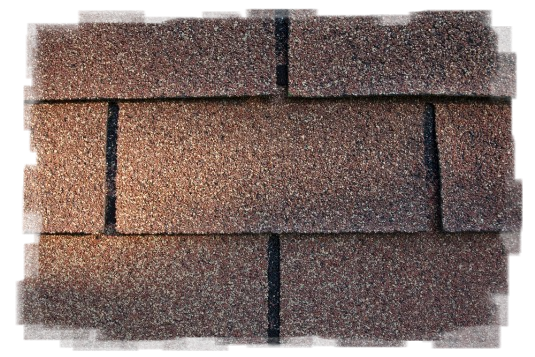
Types of Asphalt Shingles
Asphalt shingles are divided into two categories: organic and fiberglass. Organic shingles are made up of paper with an asphalt coating that converts them into a waterproof product. Fiberglass shingles provide better fire protection than organic shingles. Like organic shingles, fiberglass shingles are treated with a protective resin coating that converts them into waterproof material. New developments and technology have led to the creation of architectural shingles, using two layers bonded with a special sealant that adds an appealing visual effect to the roof.
Pros
- Easy to Install
- Economic Alternative
- Relatively large lifespan
- A wide variety of colors to choose from
- Can be recycled
Cons
- Can decay with sudden weather changes
- If possible avoid installing them in severe cold weather
- Wind can affect and generate uplift upon the shingles
- Attic ventilation problems can reduce the shingles’ life
- Although not high, maintenance is required. It is recommended to have periodic maintenance routines
- They are not an environmentally friendly product as they are made out of petroleum by-products
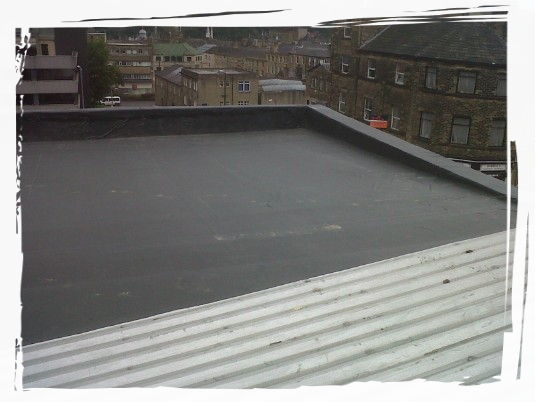
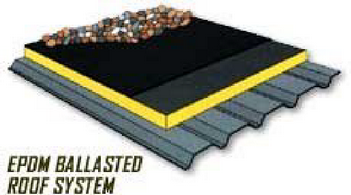
A rubber roof, known in the roofing business as an EPDM (ethylene propylene diene terpolymer) roof, has a lot of advantages and only a few disadvantages. One of the big advantages to rubber is the cost. Although a homeowner must use a licensed installer to lay down this roof, the cost of the entire job still favorably compares to the cost for other types of roofing. Not only is the roofing material itself less expensive than most other choices, but the product is also lightweight, and installation is fast and easy, reducing labor and installation costs. The rubber is glued into place, negating the use of heat, which can adversely affect a homeowner’s insurance policy.
PROS
Rubber is also long-lasting. Most of these roofs are laid in a single piece, which means there are no seams or very few, depending on the exact layout of the roof. Few seams mean few places for water to seep under the roofing and destroy the home. And because modern rubber is not susceptible to the sun’s UV and ultraviolet rays, a properly-installed rubber roof can last 50 years or even longer. Rubber can withstand high winds and even hail up to three inches in diameter. Many rubber roofs laid down in the 1970s are still in use today.
Another large advantage of rubber is that if the roof ever does have a leak, repairs are fast, easy and extremely inexpensive. In many cases a tube of liquid rubber is all that is needed; in other cases, a special tape designed specifically for repairing rubber will do the job. In any event, repairing one of these roofs, if and when it should become necessary, is almost never a problem.
Maintenance is another advantage. Almost all roofing materials require some maintenance over the years, but rubber requires little if any care. The most that a homeowner may wish to do is to repaint the roof with acrylic paint once every 10 to 12 years.
Rubber roofs come in a variety of thicknesses, from 45 mm all the way up to 90 mm. Which size is right for any particular home depends on the location of the home, the pitch of the roof and several other factors. Homeowners are encouraged to talk to the knowledgeable roofing experts at United Home Experts to learn which thickness is right for their home and to ask any other roofing questions. The experts at United Home Experts sell and install a wide range of roofing products, so their honest answers are never based on commissions.
Rubber is also one of the “greenest” choices that a homeowner can make. The rubber itself takes less energy to produce than most other roofing materials and is often made from recycled materials, to begin with. And the roof is 100% recyclable at the end of its long life.
Rubber is fire resistant. Not only is such a roof almost impossible to set afire, even with a lightning strike, but the rubber is actively resistant to all forms of fire and can slow a fire to the point that help has time to arrive. Homeowners should check with their homeowner’s insurance to see if there is a rate reduction for installing an EPDM roof.
EPDM roofs are also extremely energy efficient. An EPDM roof reflects the sun’s heat, especially the lighter-colored roofs designed for residential use, saving the homeowner considerably on air conditioning costs. EDPM also insulates the home, trapping in heat to reduce energy costs and utility bills in the colder months. The homeowner does not have to worry about the rubber freezing or cracking under extremes of cold weather. Modern EPDM roofing is designed to take both extremes of cold as well as heat.
CONS
One of the primary drawbacks to a rubber roof is its appearance. Most EPDM roofs are black. However, many manufacturers now make a white or off-white for residential use, and it is very easy and inexpensive for a homeowner to have an EPDM roof painted almost any color with an acrylic paint. The use of an acrylic paint is actually recommended as it prolongs the life of the roof even longer.
Some manufacturers are also producing EPDM roofing in long thin strips, which can be cut to resemble shingles. These faux shingles must still be installed by a professional, but they can go a long way to making an EPDM roof look almost identical to most other roofs in a neighborhood. And, of course, rubber shingles can be painted almost any color to resemble other types of roofs while still providing the homeowner with 50 years or more of unsurpassed protection.
Finding the right roofer can also be a problem. Many roofers pretend to be proficient in installing EPDM when, in fact, they are not. Using the wrong roofer to install a rubber roof can lead to problems down the line due to incorrect installation and can even negate a warranty on the rubber itself.
Virtually the only negative for a rubber roof is appearance, and even that drawback can be overcome with the use of rubber shingles or acrylic paint. With each passing week, new tweaks are being made in the fast-changing world of rubber roofing, so it be-hooves a homeowner to speak with the roofing experts at United Home Experts for the very latest information on rubber roofs.
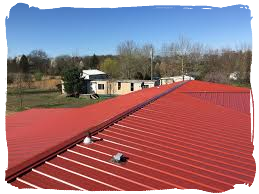
Unlike asphalt or other roofing styles, a
properly constructed metal roof can handle just about anything
Mother Nature can throw at it. Metal roofing can protect your
home against extreme temperatures, high winds, hail, marine air
and even fire—all with minimal maintenance.
PROS
Metal beats out conventional roofing materials in several ways:
Expected life.
Properly installed, a metal roof should last as long as the
house, sealing out water, surviving high winds, and easily
shedding snow. Metal is resistant to fire, mildew, insects, and
rot.
Warranties
vary widely, but most companies back their products for 20 to 50
years. Paint finishes typically have a 30-year limited warranty.
Weight.
Compared to the weight of tile at 750 pounds per square (an area
equal to 100 square feet) or concrete tile at 900 pounds per
square, metal roofing is very lightweight. Most varieties run
from 50 to 150 pounds per square.
Because
of the material’s light weight, you can save on engineering and
building the supporting structure. In fact, if you’re building a
house or an addition, you can often downsize or reduce the number of
roof support members.
Some
types of metal roofing materials may be applied over an existing
roof without the need for tear-off or additional structural
support.
Speed & ease of roofing installation. Most metal roofing materials come in multiple-shingle sections or in 12- to 36-inch-wide panels.
An
accomplished contractor can install these quickly. If your roof
is stripped off and a storm is on the way, shortening the process
by a day or two may offer a critical advantage. Obviously,
there is also considerable labor savings if you can ease and
shorten the duration of roof installation.
Fire resistance.
Because metal roof materials are noncombustible, they typically
have a Class A fire rating (the most fire-resistant rating). Just
be aware that part of a roof’s overall classification depends on
materials beneath the surface that could ignite in intense heat,
too. Most metal roofs applied over a combustible material such
as wood shingles have a lower, Class C rating for this reason.
See notes under “Metal Roofing Drawbacks” regarding problems in
the event of a house fire.
Heat conduction.
Metal reflects radiant heat from the sun, minimizing midday heat
gain. This means you save energy needed for air conditioning
during the day. Though the material itself is low in insulation
R-value, metal roofing can be applied over rigid-foam insulation
that has very high R-values. In addition, many systems utilize a
dead-air space between the metal and roof deck to increase energy
efficiency.
Minimal roof pitch.
Most metal roofing materials can be installed on gently pitched
roofs without leaking. Minimum roof pitch typically is 3-in-12
(the roof rises 3 inches for each horizontal foot).
Maximum shedding of rain and snow.
Metal roofing is practically impervious to rain and snow because
of the way the panels interlock and because the surfaces are
hard and slippery. In addition, dark tones of metal roofing
quickly warm in the snow, encouraging snow melt.
CONS
Though
metal roofing offers many pluses, a few drawbacks are worthy of
mention. For the most part, metal roofing manufacturers have
improved their products to address or solve many of these
concerns:
Cost. The
biggest drawback is initial cost. Metal roofing is equivalent in
cost to other premium materials—from about $150 to $600 per
square (100 square feet).
Because
of the material’s long-term durability, the trick is that you
ultimately save the difference (and more) if you stay in the house
for a long time and, of course, you save on seasonal maintenance.
Then again, if you plan to move in a couple of years, you
probably won’t get the return on your investment.
Noise.
For some, the sound of rain tapping on the roof is romantic and
homey. For others, it’s like living inside a drum. In a rainstorm
or hailstorm, living beneath thin sheets of metal is bound to be
noisier than living beneath thick slate or tile. Noise can be
controlled both by using materials that have structural barriers
to minimize the drumming effect and by applying them over
sound-deadening insulation and solid plywood sheathing.
Denting. Just
as your car will dent if a golf ball hits it, a metal roof can
dent if large hailstones fall on it. Aluminum and copper, much
softer than steel, are more prone to denting. Some types are
guaranteed not to dent, however.
Though
you shouldn’t have to walk on a roof that doesn’t leak, there
may be occasions when a plumber needs to snake out a vent pipe or
a chimney sweep needs access to the flue. You can walk on some
metal roofs but not all of them. This depends on how the
particular product is made and the type of construction
supporting it. As you might imagine, metal can be very slippery
when wet.
Marring & care.
Some painted metal roof finishes can peel, chip, fade, scratch,
or chalk, although nearly all are guaranteed for 30 years.
Walking on some types, particularly those with a granulated-stone
surface, may cause wear.
Installers
must be careful not to scratch or dent the roofing during
installation, and panels must be treated with care. Unlike
conventional roofing, some metal shingle systems are installed
from the top down, eliminating the need to walk on them. Once installed,
you may need to hose off roofing now and then to keep it looking
good.
Leaking.
A metal roof must be installed correctly. Roofs with exposed
fasteners are particularly vulnerable to improper installation.
If screws attach through the flat surfaces (rather than the
raised ridges), rain water can run down the roof and seep into
the screw holes. For this reason, special resilient washes must
seal around screw heads. If you install this type of roof, be
sure manufacturer’s instructions are followed precisely.
Expansion & contraction.
Because metal expands and contracts as it warms and cools, most
new products have fastening systems that accommodate movement.
Otherwise, fasteners that secure the roofing may tend to come
loose. Expansion and contraction on hot days can cause a wavy
affect.
Modifications.
Metal roofing materials installed in large panels are more
difficult to replace if damaged than individual shingles. Also,
if you remodel or add on to your home 10 or 20 years from now, it
may be difficult to match the material.
Lightning.
Many people assume that because metal conducts electricity, it
also attracts it. This really isn’t the case, and many instances
have been documented where lightning has struck trees or other
high objects located near metal roofs rather than the roofs
themselves. Just the same, metal roofs can be easily grounded by a
lightning protection company.
House fire.
Though metal roofs are good at guarding against a fire that
approaches from outside a house (such as from flying sparks and
embers), they are not ideal for fires that start inside a house.
With a serious house fire, firemen may need to cut through the
roof to put out the fire—this job can be much more difficult and
take longer if the house is capped with a metal roof.
What is a modified roof system?
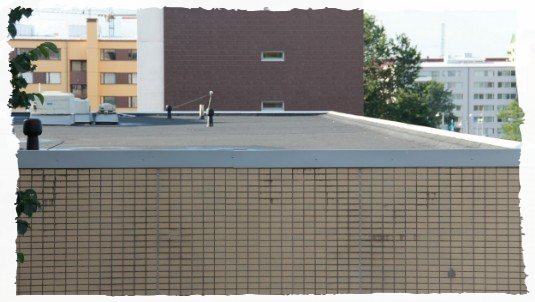
Modified bitumen roof systems can be installed with the common torch method, asphalts, or cold adhesives. A standard SBS modified bitumen roof system is a two-ply system applied in rolls that overlap the edge of the previous roll.
PROS
There are several different advantages to using a bitumen roof on
your building or home. Unlike some newer types of roofing, it has a
long, proven track record that can be counted on. Bitumen roofs are one
of the longer lasting types of flat roofing materials, easily lasting 20
years or more.
Regardless of how the material is applied (self-adhesive sheets,
hot-mopped asphalt, or cold-applied adhesives) the seams are usually
melted together which help stop leaks. Other types of membrane roofing
have seams that are left open or covered with another material that can
weaken over time, so the fact that a bitumen roof can be seamless is a
big advantage.
Bitumen roof is also very durable. They have a high-tensile strength
so they are unlikely to develop the kinds of cracks that other flat and
membrane roofs are known for. They are also rated against wind, fire,
and hail so they are unlikely to be damaged in the event of a storm.
Included in this is usually a very long manufacturer’s warranty that can
help to guarantee the roof’s longevity.
CONS
Like all roof types, a bitumen roof does have some drawbacks. The
first is their black color, which can absorb rather than reflect heat.
And while the material itself may not be damaged by heat or UV rays, if
proper insulation is not used with it, this absorption of heat can lead
to super-heating of the building below.
Bitumen roofing is also available in 1, 2, or 3-ply. The 1-ply
material is not durable, and if used can pose certain problems such as
breaking down prematurely, while the 2 and 3-ply material roofs cost
significantly more to install, which can make this one of the most
costly types of flat roofing products around.
Granules need to be included as part of the installation process to
help protect the roof from the sun. If they are not included, this can
further raise the temperature of the building or damage the roof.
Unfortunately, not all types of bitumen roofs include granules as part
of the installation process.
Finally, if your roof is likely to hold a lot of water or to gather
puddles of standing water after rainstorms, this can prematurely age and
damage the bitumen roof.